Alabama Tiny House Laws: Complete 2026 Guide (With County Examples & Park Models)
30 min read · Updated October 14, 2026
By John
Alabama does not have a single statewide set of laws governing tiny houses. What you can build, where you can place it, and how you can live in it depends on the county, the city, and whether your tiny home sits on a permanent foundation or rolls on wheels. This guide breaks down the building codes, zoning rules, park model classifications, and county-level details you need before committing to tiny living in Alabama.
Key Takeaways
Alabama's tiny house regulations vary by county and municipality, so the same 350 sq ft home can be fully legal on one parcel and prohibited on the next. Here is what matters most.
About 63% of Alabama's 67 counties do not enforce residential building codes in unincorporated areas, but cities like Birmingham, Mobile, Montgomery, and Huntsville impose stricter building rules and minimum square footage requirements that can block typical tiny houses.
Park model tiny homes (built to ANSI A119.5, 399-400 sq ft, on a chassis) are classified as recreational vehicles in Alabama. Most jurisdictions limit them to RV parks or special zones. Foundation-built tiny homes follow the IRC/IBC and are treated as traditional homes under building codes.
Baldwin County, Madison County, Mobile, and Montgomery have adopted modern IRC editions (2018 through 2024) with tiny house appendices (Q, AQ, or BB). Many other counties rely on the baseline state code or have no adopted code at all.
Always confirm details with local zoning or building departments before purchasing land or a home. You can browse Alabama tiny homes, land, and tiny home communities through TinyHomeMap's map-based directory.
How Alabama Regulates Tiny Houses (Big Picture)
Alabama relies on a layered system: state-adopted building codes set a floor, counties choose whether to adopt those codes (or go further), and each city or town writes its own zoning ordinances. Local municipalities control zoning and building codes for tiny homes in Alabama, which means research at the local level is unavoidable.
The state has moved through multiple International Residential Code editions. As of July 1, 2022, Alabama formally adopted the 2021 IRC along with related I-Codes. Alabama adopted the 2021 International Building Code for tiny homes as the statewide building code baseline. On March 17, 2025, portions of the 2024 IBC were layered on top. Some jurisdictions have explicitly adopted tiny house appendices (Q, AQ, or BB), while others have not.
"Building codes" govern safety: structural integrity, egress windows, fire separation, plumbing, and electrical standards. "Local zoning" governs land use: what can go where, minimum lot size, minimum square footage, density, and how many units fit on a parcel. A project must pass both sets of rules.
Unincorporated land in many counties has no local building department and limited enforcement. That said, state standards, septic regulations, floodplain rules, and subdivision regulations still apply. Many Alabama counties allow tiny homes but vary in regulations from one jurisdiction to the next.
Classification is the single biggest variable. A park model tiny home on a chassis is an RV. A site-built 350 sq ft cottage on a slab is a dwelling. A modular unit trucked in and bolted to a foundation is treated differently from both. Each classification triggers a different regulatory path.
On TinyHomeMap, listings carry tags like "Park Model," "THOW," "On Foundation," and "Off-Grid" so users can filter based on the type of regulation they are more likely to encounter in Alabama.
Definitions: Tiny House vs Park Model vs Small House in Alabama
Before contacting any planning department or builder, you need to know which category your home falls into. Tiny homes must be under 400 square feet in Alabama to qualify under the tiny house appendices. These three categories determine everything from financing to placement rules.
A tiny house in code terms is generally 400 sq ft or less of floor area (excluding lofts). Appendix Q of the International Residential Code addresses tiny home specifics, including relaxed ceiling height in lofts (minimum 6 ft 8 in at the low side), compact stair or ladder access, and adjusted egress window dimensions. Building codes for tiny homes depend on whether they are on a foundation or on wheels.
A park model tiny home is a factory-built structure on a chassis, typically maxing out at 399 square feet. Park models must be 400 square feet or less in size, built to ANSI A119.5, and often carry RVIA certification. Park model tiny homes are classified as recreational vehicles in most Alabama jurisdictions. Think of it as a cozy cabin on wheels with full kitchen and bath.
Homes between roughly 400 and 800 sq ft are treated as standard small houses under the main body of the IRC/IBC. They do not benefit from the relaxed appendix rules; instead, they must meet every conventional requirement for ceiling height, room size, and egress that applies to any dwelling.
This distinction matters for four practical reasons: where the home can be placed (RV parks vs a legal lot in a residential zoning district), financing type (RV loans vs mortgage vs personal loans), insurance availability, and whether the unit qualifies as a permanent dwelling. A 320 sq ft park model delivered on a trailer faces entirely different local regulations than a 480 sq ft cottage poured on a slab.
Alabama Building Codes for Tiny Houses (2021-2024 Updates)
Alabama has formally adopted recent building code editions at the state level, but local governments decide which version and which appendices actually apply within their boundaries. Tiny homes must comply with Alabama state building codes, and the specific edition in force depends on your city or county.
Many counties and cities still reference the 2018 or 2021 IRC. Larger jurisdictions have moved ahead. Montgomery adopted the 2024 IRC including Appendix BB for tiny houses. Mobile City adopted the 2021 IRC with Appendix AQ, which sets requirements for tiny houses 400 square feet or less. Appendix AQ of the International Residential Code covers reduced ceiling heights in lofts, alternate stair designs, and compact egress provisions.
Key appendix requirements across Q, AQ, and BB share a common framework: maximum footprint of 400 sq ft (excluding lofts), reduced loft ceiling heights, allowance for ladders or alternating-tread stairs, and modified emergency escape windows. The specific measurements differ by edition. Appendix BB in the 2024 IRC, for instance, refines loft guardrail heights.
Not every jurisdiction that uses the 2018, 2021, or 2024 IRC has adopted the tiny house appendix. Some explicitly exclude Appendix Q, AQ, or BB, leaving tiny houses to be treated as standard small dwellings under the full IRC requirements. This means a 350 sq ft home may need 7 ft ceilings everywhere, standard stairways, and full-size egress windows even if the appendix would allow smaller ones.
Jurisdictions with confirmed tiny house appendix adoption include Baldwin County, Madison County, Mobile City, Montgomery City, and several smaller municipalities. Alabama's residential building code framework is transitioning, with Section 34-14A-12.1 taking effect January 1, 2027, requiring every residential builder to follow either the state-adopted code or the local jurisdiction's adopted building code.
In jurisdictions with no adopted building codes (common in rural areas), there may be no building inspections at all. But state septic rules, floodplain ordinances, and lender or insurer requirements still shape what can be built safely.
Local Zoning: Where Tiny and Park Model Homes Can Go
Zoning, not building code, is usually what stops or allows tiny living in Alabama. A home can meet every IRC requirement and still be prohibited on a given parcel because the zoning district does not permit that use. Zoning laws in Alabama vary greatly by city, county, or municipality.
Zoning districts (R-1 single-family, agricultural, manufactured home communities, RV parks) decide whether a tiny home or park model is generally permitted, conditional, or prohibited. In rural areas, zoning regulations for tiny homes are often less strict or absent. Zoning permits may be required for tiny homes in specific areas, depending on local rules.
Shelby County allows tiny homes on legal lots of any size in certain unzoned or manufactured home areas. Jefferson County allows tiny houses up to 200 square feet as accessory dwelling units in some residential zones. Rural counties like Crenshaw or Dallas often have almost no zoning in unincorporated areas, but cities inside them are stricter.
Typical zoning restrictions include minimum square footage for principal dwellings, a requirement for a permanent foundation, bans on RVs or THOWs as primary housing in residential zones, and density limits controlling how many units can occupy one acre. Zoning approval does not guarantee that a tiny house meets building code requirements; you must satisfy both.
Several cities outright prohibit tiny homes or park model homes as dwellings inside city limits, even when the surrounding county is flexible. Homeowners Associations can impose additional restrictions on tiny houses beyond municipal laws, adding another layer to check before buying.
Inside city limits vs. rural/unincorporated at a glance:
Inside city limits: formal zoning maps, minimum dwelling sizes (often 800-1,200 sq ft), driveway and parking requirements, design review, and strict treatment of THOWs and park models as temporary or prohibited.
Rural/unincorporated: often no local building inspections, no minimum home size, tolerance for long-term park model and RV stays, subject mainly to septic, road access, and floodplain rules.
Minimum Square Footage and Room Size Rules
Many Alabama cities have minimum square footage requirements that can prohibit tiny homes. Understanding how zoning ordinances interact with building code room-size rules helps you figure out what you can actually build.
Under the IRC framework, a habitable room (excluding kitchens and bathrooms) must be at least 70 sq ft in area with a minimum dimension of 7 ft in any horizontal direction. Ceilings in habitable spaces must be at least 7 ft high. These building rules shape how compact an Alabama tiny house can realistically be, even in jurisdictions that adopt the tiny house appendix. A 350 sq ft home can still include a living area (at least 70 sq ft), a bedroom (at least 70 sq ft), a kitchen, a bathroom, and a loft, while meeting code.
Some Alabama cities and HOAs impose minimum dwelling sizes of 800 to 1,200 sq ft. A 350 sq ft foundation-built tiny house meeting Appendix Q may be legal in a flexible rural area with no minimum square footage requirements, but the same house would violate a suburban subdivision's 1,600 sq ft minimum and the HOA covenant on top of it.
Jefferson County's 200 sq ft accessory dwelling unit allowance applies to backyard units, not always to a primary residence. A homeowner wanting a tiny home as their sole dwelling in that zone would face a different standard. Madison County permits ADUs sized 500-900 square feet, giving more room for a functional small house as a secondary unit.
A compliant layout example: a 380 sq ft cottage with a 12 x 8 ft living room (96 sq ft), a 9 x 8 ft bedroom (72 sq ft), a 6 x 8 ft kitchen, a 5 x 7 ft bathroom, and a sleeping loft above the kitchen accessible by alternating-tread stair. Every habitable room exceeds 70 sq ft, and the home fits within the 400 sq ft appendix limit.
Park Model Tiny Homes in Alabama: Laws and Classifications
Park model tiny homes are popular in Alabama for lakeside, resort-style, and seasonal living. Properties located near lakes and along the Gulf Coast attract buyers who want a turnkey structure without pouring a foundation. But the regulatory classification creates complications for anyone planning full-time use.
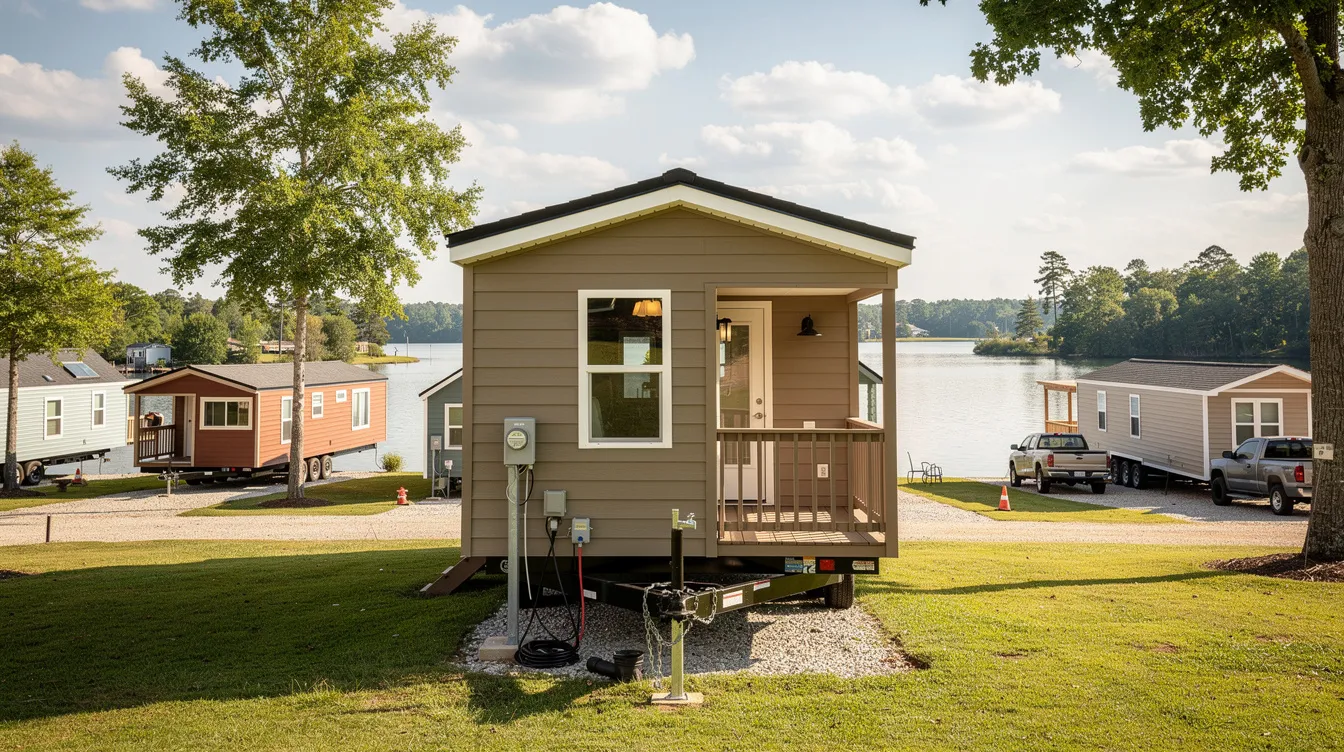
In Alabama terms, a park model is a factory-built unit under 400 sq ft on a permanent chassis, compliant with ANSI A119.5, and usually bearing an RVIA seal. Park model tiny homes typically max out at 399 square feet. Because of the chassis, most counties treat them as recreational vehicles rather than dwellings.
RV classification means many jurisdictions limit park models to RV parks, campgrounds, or designated RV zones. Full-time year-round occupancy is often restricted, with some counties capping stays at 180 days. Tiny homes on wheels often require placement in RV parks under RV rules.
Baldwin County allows park models on zoned RV lots. Shelby County permits them on legal lots in certain unzoned areas. In contrast, many cities have no explicit park model language in their code, requiring case-by-case approval from local officials. Park models can be placed on permanent foundations in some counties, but the process typically involves re-inspection to residential standards.
Even if a park model is de-wheeled and skirted, some inspectors still classify it as an RV unless it is rebuilt to residential code on a permanent foundation with full structural, plumbing, and electrical inspections. Simply removing axles does not convert an RV into a permanent structure.
On TinyHomeMap, park model listings disclose ANSI/RVIA certification and intended use (seasonal vs. full-time) to help buyers align with Alabama's placement rules.
County Examples: Baldwin, Madison, Jefferson, Mobile & More
Rules vary so much by county that a parcel in one county can welcome a 350 sq ft cottage while the next county over may not know how to permit it. Here are the counties that come up most in Alabama tiny house research.
Baldwin County adopted the 2024 IRC and IBC via Resolution 2025-067, effective March 5, 2025, with local amendments. Baldwin County allows tiny homes under the 2018 IRC and subsequent editions. The county requires engineered plans for new residential construction and enforces floodplain, beach/dune, and energy codes. Park model tiny homes on RV-zoned lots are permitted. Foundation-built tiny houses on residential parcels must meet the adopted building code and septic requirements.
Madison County follows the 2018 IRC with Appendix Q for tiny homes. Madison County permits ADUs sized 500 to 900 square feet, and minimum lot sizes for ADU parcels range from 7,500 to 15,000 sq ft in Huntsville's zoning districts. Rural lots outside Huntsville city limits are more permissive, but the city's inspections department should be consulted before setting up a park model for full-time residence.
Jefferson County has an uncertain stance on tiny and park model homes as primary dwellings, but clear rules allow small ADUs of about 200 sq ft when they meet setback and utility requirements. Jefferson County allows tiny houses up to 200 square feet as ADUs in certain residential zones. For a permanent tiny house as a primary dwelling, contact the building division directly.
Mobile City adopted the 2021 IRC including Appendix AQ. Mobile County has adopted the 2018 International Building Codes. The city's unified development code allows ADUs by right in residential zones. Foundation-built tiny homes that meet code are accepted as dwellings, but there is no explicit park model language; owners must check with the planning and development department.
Many other counties (Dallas, Crenshaw, Covington, Geneva, Lawrence) do not enforce building or zoning codes in unincorporated areas, effectively allowing tiny homes and park models with minimal oversight. Septic and environmental rules still apply in every location.
Unincorporated vs City Limits: Two Very Different Alabama Experiences
Your tiny house prospects in Alabama can flip entirely depending on which side of a city boundary line your property sits. A THOW on private land in rural Alabama may draw zero regulatory attention, while the same unit three miles away inside a local city is subject to code enforcement.
On unincorporated rural land, there are often no local building inspections, no minimum home size, and broad tolerance for off grid living, foundation tiny houses, and long-term park model stays. The primary checks come from the county health department (septic permits), road access, and floodplain compliance.
Inside city limits, zoning maps, minimum square footage rules, driveway requirements, design standards, and strict classification of THOWs and park model tiny homes as temporary or prohibited dwellings are the norm. Living in a tiny house on wheels full-time is often limited to licensed RV parks or campgrounds within incorporated areas.
Consider Coffee County or Dale County: a THOW on private land outside town may be effectively unregulated, while inside the city of Dothan, that same unit is barred as a permanent residence by the municipal zoning ordinance.
TinyHomeMap listings for Alabama include location context (nearest town, county) so users can focus on rural parcels and tiny-friendly communities to reduce zoning friction. Keep in mind that even unincorporated parcels in coastal hurricane-prone areas still face elevation, wind-load, and foundation requirements that add cost and complexity.
Off-Grid Living and Utilities for Alabama Tiny Houses
Alabama allows off-grid tiny homes in rural areas, and the state's mild winters, long growing season, and inexpensive rural land make off grid living attractive. But "off-grid" does not mean "unregulated."
County health departments typically require an approved septic system (or other permitted waste disposal solution) for any dwelling with a bathroom, even in counties with no building department. Permanent tiny homes must connect to approved municipal utilities or a local septic system. Utilities and septic systems must be approved for tiny houses intended for permanent residency.
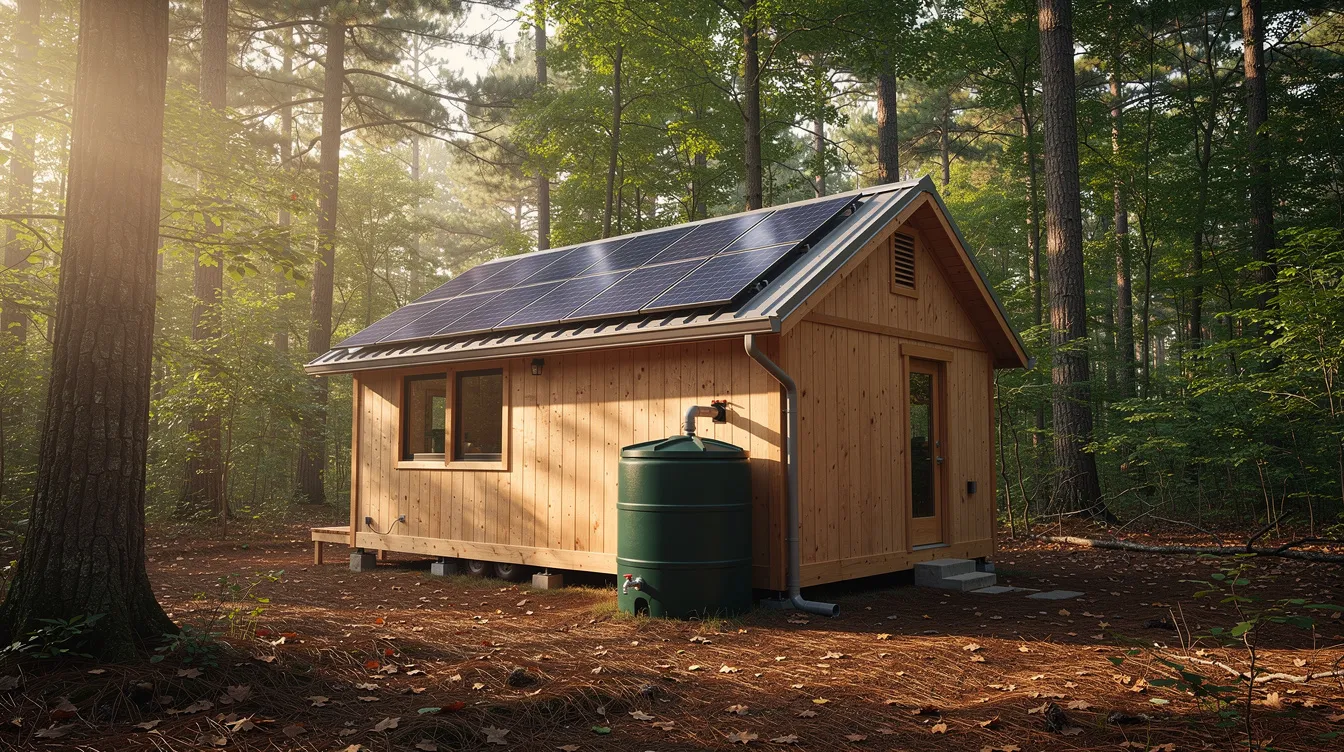
Common off-grid options in Alabama include solar power with battery storage, rainwater collection plus filtration, wells, composting toilets (where permitted by the county health department), and propane for cooking and backup heat. Off-grid living requires planning for water, power, and waste before you break ground.
Coastal counties along the Gulf Coast layer on floodplain ordinances and wind-load requirements that affect where and how a tiny or park model home can be set up off-grid. Elevation requirements in flood zones can add $10,000 or more to foundation costs.
Ask power co-ops and rural water authorities about connection fees and distance-based costs before buying land. Long service runs across several hundred feet of rural road can exceed $15,000 and sometimes rival the cost of the tiny house itself. Alabama's climate supports off-grid gardening and solar power, with average peak sun hours of 4.5-5.5 per day across most of the state.
On TinyHomeMap, filter for "off-grid ready" or "solar included" Alabama tiny home listings when you want minimal dependence on public utilities.
Legal Lot, Setbacks, and Driveway Access
A legal lot is a parcel created in accordance with subdivision regulations, with recorded access (a road or easement), and compliant with any minimum lot-size requirements for that zoning district. These requirements apply to tiny homes exactly the same way they apply to a 3,000 sq ft house.
Most Alabama jurisdictions require setbacks from property lines (front, side, rear), which can make placing multiple tiny homes, ADUs, or park models on a parcel more difficult than the square footage alone would suggest. A 50 x 100 ft lot with 25 ft front, 10 ft side, and 15 ft rear setbacks leaves a buildable area that may fit only one small structure.
Some rural parcels lack legal road access or recorded easements, making it impossible to get a building permit or an address for utilities, mail, and emergency services. Without a legal lot, lenders and insurers will not touch the property.
Order a title report or speak with a local attorney to confirm legal access and subdivision status before moving a tiny or park model tiny home onto land. TinyHomeMap land listings aim to disclose road type (paved, gravel, easement only) so tiny home buyers can avoid parcels with problematic access.
Foundation Tiny Houses vs THOWs vs Park Models: How Alabama Treats Each
The same 350 sq ft floor plan can face three different regulatory paths depending on whether it is built on-site, manufactured and trucked in, or placed on a trailer chassis.
Foundation-built tiny houses are treated like conventional homes. Tiny homes on foundations are treated as traditional homes under building codes. They must follow the adopted IRC/IBC (and tiny house appendices if adopted) and are eligible as a permanent dwelling when zoning allows. Foundation-built tiny homes are treated as permanent dwellings, and they qualify for standard homeowner's insurance and property-tax classification.
Tiny houses on wheels (THOWs) are almost always classified as recreational vehicles by Alabama jurisdictions. Tiny homes on wheels are often classified as RVs in Alabama, and that classification restricts them to RV parks, campgrounds, or limited-duration stays on private land. They are rarely accepted as a full time residence in standard residential zones. If building a tiny home on wheels, check local zoning and building codes before assuming you can park it anywhere.
Park model tiny homes are factory-built RVs under 400 sq ft on a chassis. They can sometimes serve as long-term or seasonal housing in RV parks and, in a few counties, on legal lots in unzoned areas. Converting a THOW or park model into a code-compliant dwelling requires foundation installation plus inspections to residential standards, not just removing the wheels and axles.
When browsing TinyHomeMap in Alabama, pay attention to listing type and ask the seller or builder which code or standard (IRC, ANSI A119.5, HUD) the unit was built to.
Building Permits and Inspections: When You Need Them
Alabama requires permits for tiny homes used as dwellings. Most counties require a building permit for any dwelling with utilities, even if the structure is "tiny." Building permits are needed for tiny homes on foundations in every jurisdiction that enforces the adopted building code.
Counties like Barbour, Montgomery, Houston, and others either issue building permits themselves or delegate permitting to cities inside the county. In most regulated counties, a tiny house with plumbing and electrical needs some combination of building, electrical, septic, and driveway permits, along with inspections and a certificate of occupancy if used as a home. Tiny homes require permits for use as dwellings in Alabama.
A park model tiny home delivered to an RV park may bypass the building permit process for the structure itself but still needs approved utility hookups, adherence to park regulations, and zoning compliance. The park operator typically handles site-level permits.
Unincorporated counties like Dallas, Geneva, Limestone, and others may have no building permit requirement at all for small dwellings, while still requiring septic approval and floodplain clearance. Foundation-built tiny homes incur higher costs due to permits and inspections compared to a park model dropped on a pad.
Practical advice: always call the county building or engineering department and ask specifically "What permits do I need for a 300-400 sq ft tiny home on this parcel?" before ordering or moving a unit. Document the name, date, and instructions from whoever answers.
Alabama Tiny House ADU Rules (Backyard Units)
An accessory dwelling unit is a secondary residence on the same lot as a primary home. For Alabama suburbs and cities, ADUs are one of the most viable paths to adding a tiny house to an existing property. Some Alabama areas allow tiny homes as accessory dwelling units on lots with a primary structure.
General ADU patterns in Alabama: one ADU per legal lot, must remain smaller than the main house, typically placed behind or to the side, with separate entrances and full utility connections.
Jefferson County's ADU allowance caps at about 200 sq ft. Birmingham and Montgomery have drafted or updated ADU provisions to address housing affordability, though caps remain low compared to Madison County's 500-900 sq ft ADU allowance.
Many Alabama municipalities still ban detached ADUs entirely in low-density single-family zones or require discretionary approvals that can take months. Local authorities control how zoning and building rules intersect for these structures.
Even when an ADU is allowed, a park model or THOW may not qualify unless local code permits recreational vehicles to serve as ADUs. Most zoning ordinances require a permanent foundation for any habitable accessory structure.
TinyHomeMap can help you find ADU-suitable models (small foundation cottages and prefab units) and Alabama community listings that explicitly welcome ADUs or backyard rentals.
Tiny Home Communities and Parks in Alabama
Alabama has a growing number of tiny home communities, cottage clusters, RV resorts with park models, and ecovillages. Living in one of these developments sidesteps much of the individual permitting burden because the operator has already navigated zoning and building compliance.

Eagles Landing offers lakeside tiny homes in Equality, Alabama, with water access and scenic locations on Lake Martin. Atkinson Cottages features modern tiny homes in Childersburg, Alabama, in a community format with shared green spaces. The Cottages at Pine Lake allows full-time living in park model tiny homes in a residential-style setting.
Many of these home communities are zoned as RV parks, manufactured home communities, or planned developments, which is why park model tiny homes and small cottages are allowed in clusters. Tiny home communities in Alabama often include shared amenities and green spaces, and they promote sustainable living and social connections among residents. Imagine waking to the natural beauty of a lake or forest clearing, surrounded by neighbors who share your commitment to tiny living.
Some emerging ecovillages emphasize sustainability, food production, and shared resources, working with counties to fit under agricultural or special-use zoning. On TinyHomeMap, Alabama community listings show locations, allowed unit types (park model, THOW, foundation cottage), and whether nightly, monthly, or long-term stays are possible.
How Many Tiny Homes Can You Place on One Parcel in Alabama?
The limit is rarely defined by "tiny" status. Zoning density rules and lot-size minimums control how many units fit on any property, regardless of size.
Most single-family zones allow one primary dwelling plus, at most, one ADU. Multiple tiny homes on a single parcel require multi-family zoning, a special-use permit, or licensing as an RV park or manufactured home park.
Minimum lot sizes (1 acre per dwelling in some rural zones, 7,500 sq ft per dwelling in some suburbs) effectively cap density. Alabama counties might allow tiny home communities or multiple park models under RV park or campground zoning, often with density caps and infrastructure requirements for water, septic, and road access.
Would-be community developers should work closely with county planners to explore cluster development, planned unit development (PUD), or similar pathways outlined in local comprehensive plans. TinyHomeMap is used by some community operators in Alabama to attract residents once their zoning and density approvals are in place.
Financing, Insurance, and Taxes for Tiny Homes in Alabama
Classification (RV vs. real property) drives how you finance, insure, and pay taxes on a tiny home in Alabama.
Foundation-built tiny houses meeting the adopted building code are usually taxed as real property, can be financed via construction or home loans, and qualify for standard homeowners' insurance. They also may qualify for Alabama's homestead exemption, which can reduce annual property taxes on a primary residence.
Park model tiny homes and THOWs are commonly financed via RV loans or personal loans, insured with RV policies, and taxed as vehicles or personal property. Counties treat these units differently from conventional houses in their tax assessment systems.
Property tax treatment varies by county. Ask Alabama lenders and insurers whether they carry specific products for tiny homes. Verify with the county assessor how a park model or tiny cottage will be classified before closing on a purchase.
TinyHomeMap does not offer financing or legal advice, but many listed builders and community operators in Alabama can refer buyers to lenders familiar with tiny home products.
Cost to Build or Buy a Tiny House in Alabama (Including Setup)
Alabama's land costs remain low compared to coastal and western states, but site preparation can push the total budget past the price of the home itself. Building a tiny home costs between $30,000 to $100,000 depending on size, finish level, and whether it is DIY or professionally built.
DIY shell builds start around $30,000-$50,000. Professionally built park model tiny homes often run $70,000-$120,000. High-end custom tiny houses on foundations can exceed $100,000.
Common site costs: land price, access driveway, pad or foundation, septic ($8,000-$15,000), well or water tap fees, power extension, and permits. Utility hookups can add $10,000 to $15,000 to setup costs. Land preparation can increase total costs well beyond the sticker price of the home.
Coastal counties and areas with clay soils, flood-prone terrain, or steep slopes see higher foundation and septic costs, especially when wind or flood codes apply.
Compare "cheap raw land plus high setup costs" against "more expensive parcel with utilities at the road." A $5,000 raw acre two miles from the nearest power pole can cost more to develop than a $25,000 half-acre lot with water, sewer, and electricity at the road.
TinyHomeMap Alabama listings typically show asking price for home or land only. Budget separately for all local setup and permitting expenses.
Best Areas in Alabama for Tiny House and Park Model Living
For those wanting minimal regulation and potential off-grid setups, rural parts of Baldwin County, Cullman, Lawrence, Geneva, Crenshaw, and similar counties offer inexpensive land and few zoning restrictions. Check septic and access before committing.
"Balanced" areas near major metros offer a middle ground. The outskirts of Birmingham (Jefferson and Shelby counties), Huntsville (Madison and Limestone counties), Montgomery, and Mobile have building codes in place, but some zones still welcome small cottages and park models. These areas provide more services and infrastructure while keeping some flexibility for tiny home living.
Lake and river regions are hotspots for park model tiny homes and vacation-oriented communities. Lake Martin, the Coosa River corridor, and the Gulf Coast attract buyers looking for scenic locations and waterfront access. These areas often zone for RV parks and resort-style developments, making park models a natural fit.
Strict HOAs and master-planned subdivisions around cities are usually poor fits for tiny homes due to minimum square footage and RV restrictions. On TinyHomeMap, zoom into these regions and filter for "Tiny Home Friendly" land, "Park Model" units, or "Community Lots" in Alabama.
Working With Alabama Builders and Nationwide Delivery
Alabama residents can choose between in-state builders, regional modular companies, and national manufacturers offering nationwide delivery of tiny and park model homes. Each option has trade-offs.
Local Alabama builders bring familiarity with regional building codes, soil conditions, wind and flood requirements, and relationships with local inspectors. They can usually provide engineer-stamped plans that your county's building department will accept without revision.
Park model builders and some cabin manufacturers offer nationwide delivery, including to Alabama, and typically build to ANSI A119.5 with RVIA certification. Confirm who handles transport, site placement (blocking, anchoring), and hookups, and whether the builder assists with local permit drawings.
On TinyHomeMap, builder profiles often show delivery radius, build standards (IRC vs. ANSI vs. HUD), and customization options. Compare at least two or three Alabama-compatible builders to match your budget, your park model vs. foundation preference, and your desired level of off-grid readiness.
Using TinyHomeMap to Find Alabama Tiny Homes, Land & Communities
TinyHomeMap is a global directory with map-based search that helps people narrow down tiny home options by location, price, and type. For Alabama, the platform aggregates listings for tiny homes for sale, rentals, park model tiny homes, land, and communities.
Zoom into Alabama on the interactive map and filter by listing type: homes for sale, rentals, park models, land for tiny homes, and communities.
Key filters for Alabama shoppers include price range, size (minimum and maximum square footage), on-grid vs. off-grid, foundation vs. wheels vs. park model, and pet or short-term rental friendliness.
Land listings can be filtered by features important for Alabama tiny living: no HOA, RV-friendly, agricultural zoning, or water access.
Community listings show which developments accept park models, THOWs, or only site-built cottages.
TinyHomeMap reviews submissions before publication to help keep listing details about size, build standard, and location accurate. Users must still verify all legal details with local authorities before making a purchase.
Frequently Asked Questions About Alabama Tiny House Laws
These questions address common issues not fully covered in the sections above. Each answer gives a concise, actionable response.
Can I live full-time in a park model tiny home on my own land in Alabama?
In many Alabama counties, park model tiny homes are treated as recreational vehicles. Full-time living is often limited or only allowed in RV parks. Some rural counties and places like Shelby County do allow them on legal lots in unzoned or manufactured home communities. Check with both county zoning and, if inside city limits, the municipal planning department. Ask specifically about "park model RV, ANSI A119.5, full-time dwelling" on that parcel. Confirm maximum stay limits (some cap at 180 days) and any requirements for skirting, anchoring, and utility connections.
Will mobile home parks in Alabama accept my tiny house or park model?
Acceptance is park-by-park. Some Alabama manufactured home communities or RV parks welcome park model tiny homes that meet their age, size, and appearance standards. Others accept only HUD-code manufactured homes. Get written confirmation about allowed unit types, required certifications (RVIA, ANSI A119.5), maximum dimensions, and extra fees before moving a tiny home into any park. County zoning must also allow that combination of park use and structure type, even if the park owner agrees.
How can I make my DIY tiny house more likely to be approved in Alabama?
Design to the IRC and Appendix Q where adopted. Use standard framing practices, ensure proper egress windows, ceiling heights, and stair or ladder safety per the appendix. Hire licensed Alabama electricians and plumbers for all trade work and keep invoices and permit documents. Have construction plans reviewed by an engineer or experienced code consultant. Discuss the project with the local building department before starting work; getting early feedback prevents expensive rework.
Can I use a tiny house or park model as a short-term rental (Airbnb) in Alabama?
Short-term rental rules are hyper-local. Cities like Birmingham and some coastal destinations have specific licensing requirements and potential bans in residential zones. Even if a tiny home is legal as a dwelling, it may not be legal as a nightly rental without an STR permit, lodging tax registration, and compliance with parking and occupancy rules. Review both city ordinances and HOA or subdivision covenants before listing a tiny house as a vacation rental.
What are the first steps to start a tiny house project in Alabama?
Three concrete steps: (1) Decide whether you want a park model, THOW, or foundation-built tiny house based on how mobile you need to be. (2) Call the planning or building department for the county where you want to live and ask what is allowed on a typical legal lot. (3) Use TinyHomeMap to search Alabama listings (homes, builders, land, and communities) that match the permitted home type and your budget. Document all conversations with local officials, including names, dates, and instructions. Rules and interpretations change, so re-check before final purchase or construction.
Related articles
More guides that dig deeper into the same topics.
Ready to start searching?
Browse tiny homes, plans, builders, communities and land on the interactive map.
Explore the map